The Circus Left Town. George Stayed.
Victorian circus lore meets small-town memory

When episode #187 dropped, I promised the story of an unusual headstone in our local cemetery. The story somehow manages to be heartfelt, deeply weird, historically fascinating, and somewhat horrifying all at once.
The grave belongs to George G. Gordon, who, according to his headstone, departed this life June 11, 1872 In the 31 [sic] Year of His Age.
Also, according to the monument, it was erected in his memory by Henry Barnum and the members of the Central Park Menagerie and Circus.
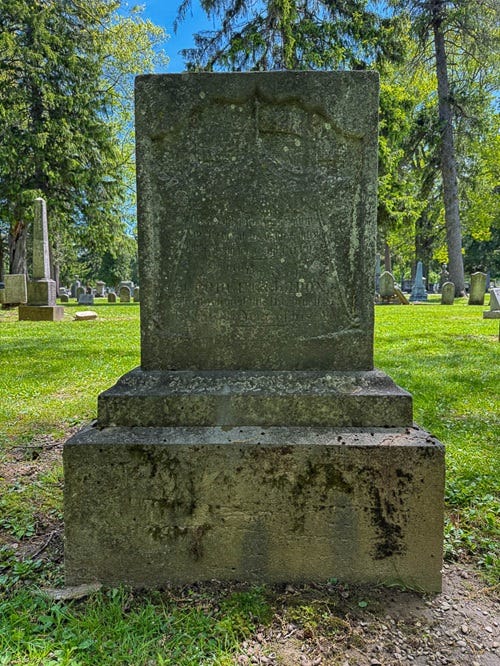
Let’s get the awful stuff out of the way right up front.
The Central Park Menagerie and Circus
The Central Park Menagerie and Circus was an enormous, but very short-lived, traveling circus and equestrian show organized by Henry Barnum in 1871. It lasted one full season and went defunct in 1873.
Henry Barnum was an experienced circus man and a distant relative of P.T. Barnum, who was already well established in the world of entertainment and human “curiosities.” That’s the Victorian-era branding buzzword for “sideshow.”
Eager to expand his reach, P.T. partnered with circus owners in 1870 to launch a wildly successful traveling human museum (gross) and arena tour.
This is pure speculation on my part, but the timing of Henry’s traveling circus is hard not to notice. I can absolutely picture Henry looking at P.T.’s success and deciding there was room for one more Barnum in the traveling entertainment business.
The Pretty Mediocre Showman
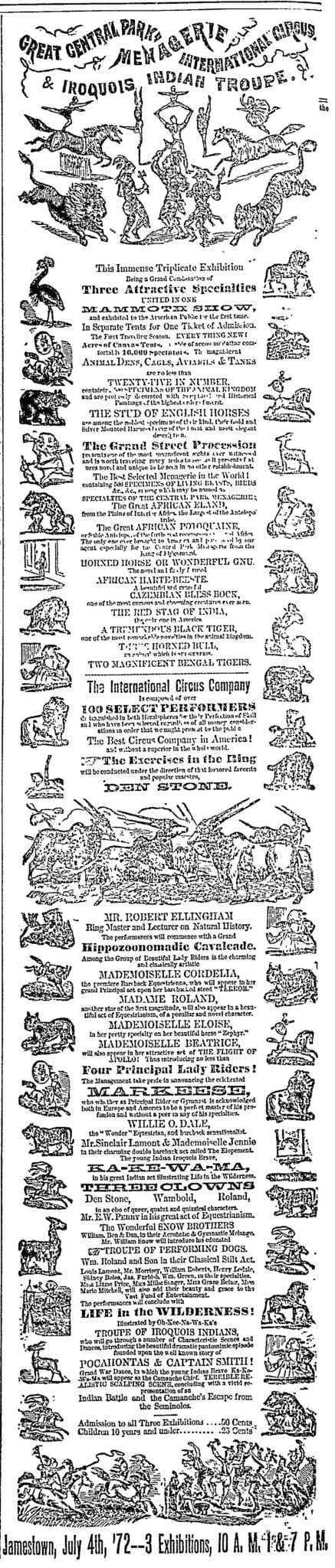
The full name of Henry Barnum’s exciting new show was the Great Central Park Menagerie International Circus and Iroquois Indian Troupe.
The show hit the road in 1872, traveling entirely by horse and wagon. It was a massive operation involving 167 men, 212 horses, and 90 wagons. Every stop required the crew to unload the entire show, set everything up for two or three performances, then dismantle it all again before moving on to the next town. Day after day, they repeated the same exhausting process.
The Central Park reference was purely a marketing ploy. The show had no affiliation with the Central Park Zoo in NYC. Based on the original advertisement, my understanding is that the exotic and rare animals were kept in cages and exhibits, as were the people in the sideshow. All of this is objectively bad by today’s standards, and it gets worse.
The Big Top event was an equestrian stunt show that ended with an act called “Life in the Wilderness.” As I was reading the description, my brain began to short-circuit a little. The performance featured the Iroquois Indian Troupe, dressed in “War Dress” and reenacting various scenes, including the “beautiful and dramatic pantomimic” story of John Smith and Pocahontas, before culminating in a staged battle and massacre reenactment.
Yes, yes, different time period, different social norms, I know. Still… yikes.
Read the original advertisement flyer.
The Show Makes the News!
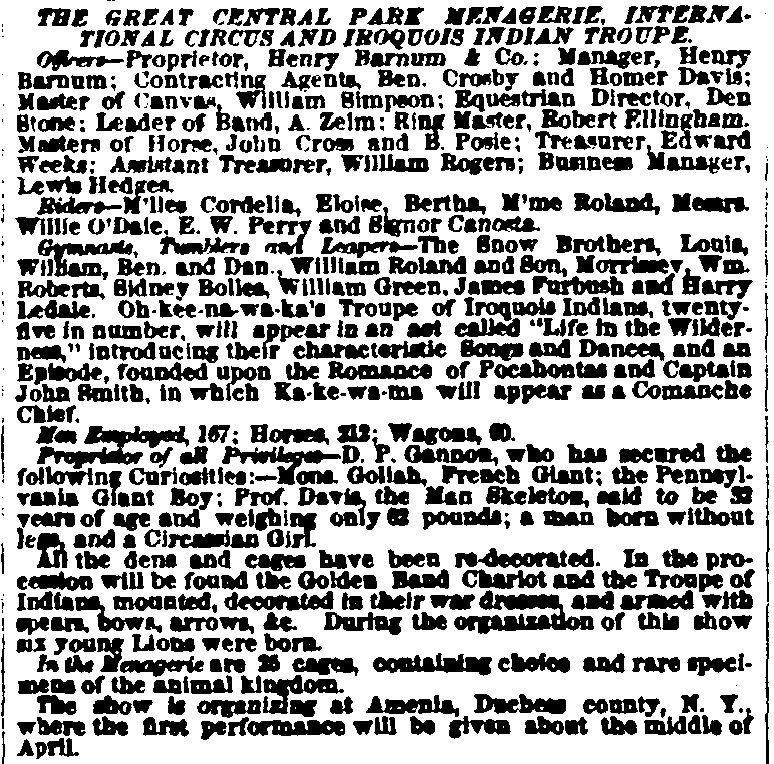
The Show Must Roll On
One day, presumably June 11, 1872, the Central Park Menagerie and Circus rolled into East Aurora, New York, and before it left, George B. Gordon became a permanent resident of the Oakwood Cemetery.
What happened to poor George is a little unclear. The story locals tend to repeat is that George was a performer who fell from a horse. The more likely scenario is that he was a foreman who died of a heart attack (at 31!) while helping raise the Big Top.
Either way, he did not leave East Aurora that night.
Small Town Kindness
When George died, the circus and townspeople held a graveside funeral service. Oakwood Cemetery donated the plot, and eventually, circus management paid for the headstone engraved with a circus tent. Over the years, I’ve heard people say George was a well-liked and important member of the crew, which is why the monument was purchased in the first place. I can’t prove that part, but it does seem unlikely they would have purchased a substantial marker for a person nobody cared about. Someone wanted George to be remembered.
Also, according to local lore, one of the women traveling with the circus was so upset about leaving George behind that she asked the children attending the funeral to promise they would place wildflowers on his grave every Memorial Day.
Remarkably, they did. Children put flowers on George’s grave for decades, continuing the tradition into the 1960s. Generations of schoolchildren visited the site on field trips, hearing the story of the circus man buried in our town cemetery. I suspect they heard a slightly gentler version of the story than the one I just told you.
George may have arrived here as a stranger, but eventually, he stopped feeling like one.
That’s the funny thing about this story. The circus itself was a mess of exploitation, spectacle, and very questionable 1870s decision-making. However, somewhere inside all of that, people still cared about George enough to bury him, mark his grave, leave flowers, and keep telling his story long after the wagons rolled out of town.
Episode 187: Beyond Old Houses: Cemetery Preservation
is available on most podcast apps, directly on the website, or as a video on YouTube.
We❤️our Sponsors
True Tales From Old Houses is supported by some of the best small businesses in the old-house community, and I am so grateful. You’ll find all the details and current coupon codes here.
Headstone Cleaning Supplies
If you’re planning to clean any headstones, historic or not, here are a few preservation-approved products and supplies to use.
D2 Biological Solution
Natural Bristle Brushes (affiliate link)
Tampico brush with an edge for scraping (affiliate link)
Water sprayers
Another reputable source for headstone cleaning and repair supplies is Atlas Preservation. The founder/owner has a proprietary cleaner called Endurance, comparable to D2.